Aquí se mostrarán las palabras que fueron desconocidas durante la lectura asignada para la primera actividad del módulo.
Closed System
Noun
In nonrelativistic classical mechanics, a closed system is a physical system that doesn't exchange any matter with its surroundings, and isn't subject to any net force whose source is external to the system. A closed system in classical mechanics would be equivalent to an isolated system in thermodynamics. Closed systems are often used to limit the factors that can affect the results of specific problem or experiment.
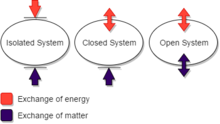
In thermodynamics, a closed system can exchange energy (as heat or work) but not matter, with its surroundings. An isolated system cannot exchange any heat, work, or matter with the surroundings, while an open system can exchange energy and matter. (This scheme of definition of terms is not uniformly used, though it is convenient for some purposes. In particular, some writers use 'closed system' where 'isolated system' is used here.
For a simple system, with only one type of particle (atom or molecule), a closed system amounts to a constant number of particles. However, for systems which are undergoing a chemical reaction, there may be all sorts of molecules being generated and destroyed by the reaction process. In this case, the fact that the system is closed is expressed by stating that the total number of each elemental atom is conserved, no matter what kind of molecule it may be a part of.
Example: Also, the simulation of a CLOSED SYSTEM with only one form of energy input is unlikely, with human intervention such as logging and fire fighting.
es: Sistema Cerrado
Conduction
Noun
Conduction refers to the transfer of energy through the movement of particles that are in contact with each other. In physics, the word "conduction" is used to describe three different types of behavior, which are defined by the type of energy being transferred:
Heat conduction (or thermal conduction) is the transfer of energy from a warmer substance to a colder one through direct contact, such as someone touching the handle of a hot metal skillet.
Heat conduction can be understood, on the atomic level, as particles physically transferring heat energy as they come into physical contact with neighboring particles. This is similar to the explanation of heat by the kinetic theory of gases, though the transfer of heat within a gas or liquid is usually referred to as convection. The rate of heat transfer over time is called the heat current, and it is determined by the thermal conductivity of the material, a quantity that indicates the ease with which heat is conducted within the material.
For example, if an iron bar is heated at one end, as shown in the image above, the heat is understood physically as the vibration of the individual iron atoms within the bars. The atoms on the cooler side of the bar vibrate with less energy. As the energetic particles vibrate, they come into contact with adjacent iron atoms and impart some of their energy to those other iron atoms. Over time, the hot end of the bar loses energy and the cool end of the bar gains energy, until the entire bar is the same temperature. This is a state known as thermal equilibrium.
In considering heat transfer, though, the above example is missing one important point: the iron bar is not an isolated system. In other words, not all of the energy from the heated iron atom is transferred by conduction into the adjacent iron atoms. Unless it's being held suspended by an insulator in a vacuum chamber, the iron bar is also in physical contact with a table or anvil or another object, and it is also in contact with the air around it. As air particles come into contact with the bar, they too will gain energy and carry it away from the bar (though slowly, because the thermal conductivity of unmoving air is very small). The bar is also so hot that it is glowing, which means that it is radiating some of its heat energy in the form of light. This is another way in which the vibrating atoms are losing energy. If left alone, the bar will eventually cool down and reach thermal equilibrium with the surrounding air.
Example: The heat exchanger is insulated from its surroundings, the only heat exchange is between hot and cold fluids CONDUCTION along the walls is negligible Potential and kinetic energy changes are negligible Fluid is flowing in one direction inside each tube All fluids enter the heat exchanger with uniform velocity Analytical 'Forced' Errors When calculating the pressure loss coefficients in the analysis of the fin designs only two graphs were available to extract data.
es: Conducción
Consist of
Verb/Noun
Be composed or made up of.
A set of railroad vehicles forming a complete train.
Example: The method is extremely useful for producing small amounts of DNA even if degraded, the starting material may only CONSIST OF a single cell, and samples that were dried, mummified, embedded in amber and buried have been examined and amplified in this way.
es: Consiste en
Convection
Noun
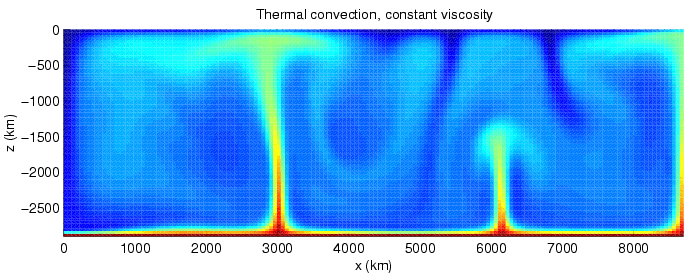
Convection is single or multiphase fluid flow that occurs spontaneously due to the combined effects of material property heterogeneity and body forces on a fluid, most commonly density and gravity (see buoyancy). When the cause of the convection is unspecified, convection due to the effects of thermal expansion and buoyancy can be assumed. Convection may also take place in soft solids or mixtures where particles can flow.
Convective flow may be transient (such as when a multiphase mixture of oil and water separates) or steady state (see Convection cell). The convection may be due to gravitational, electromagnetic or fictitious body forces. Heat transfer by natural convection plays a role in the structure of Earth's atmosphere, its oceans, and its mantle. Discrete convective cells in the atmosphere can be identified by clouds, with stronger convection resulting in thunderstorms. Natural convection also plays a role in stellar physics. Convection is often categorised or described by the main effect causing the convective flow, e.g. Thermal convection.
Thermal image of a newly lit Ghillie kettle. The plume of hot air resulting from the convection current is visible.
Convection cannot take place in most solids because neither bulk current flows nor significant diffusion of matter can take place.
Example: U may be predicted from forced CONVECTION correlations.
es: Convección
Deal With
Verb
1: to be about (something) : to have (something) as a subject
Her speech dealt with health care and the nation's economy.
The film deals with some serious issues.
2: to make business agreements with (someone)
He deals fairly with all his customers.
Their salespeople are very easy to deal with.
3: to do something about (a person or thing that causes a problem or difficult situation)
The government dealt harshly with the rebels.
I'll deal with you later.
We weren't able/equipped/prepared to deal with such a large crowd of people.
4: to accept or try to accept (something that is true and cannot be changed)
She's still trying to deal with his death.
The weather is bad, but we'll just have to deal with it.
Example: The construction of runoff collection and storage basins is strongly recommended to DEAL WITH the requirements of these regulations because the reuse of irrigation waters reduces the volume of fresh water used for irrigation and limits the release of nutrients and pesticides to the environment.
es: Tratar con
Fixed Mass
Noun
Mass is both a property of a physical body and a measure of its resistance to acceleration (rate of change of velocity with respect to time) when a net force is applied.[1] An object's mass also determines the strength of its gravitational attraction to other bodies.
The SI base unit of mass is the kilogram (kg). In physics, mass is not the same as weight, even though mass is often determined by measuring the object's weight using a spring scale, rather than balance scale comparing it directly with known masses. An object on the Moon would weigh less than it does on Earth because of the lower gravity, but it would still have the same mass. This is because weight is a force, while mass is the property that (along with gravity) determines the strength of this force.
Example: A system of fixed mass is called a closed system and a system that involves mass transfer across its boundaries is called an open system or control volume.
es: Masa Fija
Heat Transfer
Noun
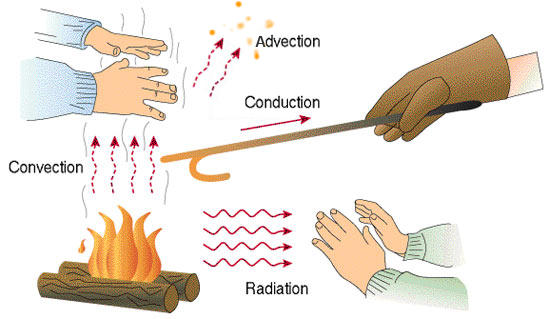
Heat transfer, any or all of several kinds of phenomena, considered as mechanisms, that convey energy and entropy from one location to another. The specific mechanisms are usually referred to as convection, thermal radiation, and conduction (see thermal conduction). Conduction involves transfer of energy and entropy between adjacent molecules, usually a slow process. Convection involves movement of a heated fluid, such as air, usually a fairly rapid process. Radiation refers to the transmission of energy as electromagnetic radiation from its emission at a heated surface to its absorption on another surface, a process requiring no medium to convey the energy.
Transfer of heat, whether in heating a building or a kettle of water or in a natural condition such as a thunderstorm, usually involves all these processes.
Example: On the surface deposits of materials can accumulate that reduce the HEAT TRANSFER and increase the pressure drop.
es: Transferencia de calor
Inner surface
Noun
I've written sloppily: "Why are charges not induced on at least that portion of the inner surface?". As I ask, I don't see how the charge density on the interior of the hollow space is zero everywhere. Typically, at static equilibrium, (unless there's a cavity with a charge inside), a charged conductor's net charge will sit at the outer surface of the conductor. I don't know why, if a conductor has an empty cavity why charge on the conductor will sit on the outer surface rather the inner one. Will charge sit on the conductor's outer surface if it has no net charge? My guess is yes although there will be no net charge from these particles on the surface, but if it is a charged conductor, say with charge +Q, then all the positive charges making up this +Q will sit on the outer surface.
With an empty cavity, I don't see how they couldn't theoretically sit on the inner surface, and in the instance below I don't see how this can't happen. As I've illustrated, the positive charge should polarize the conductor to some degree, with negative charges flowing towards it and positive charges flowing away to it. As such, I'd assume negative charge would collect on the half of the sphere closer to the +q and more negative charge on the inner surface closer to the charge. This seems like what the charges would do given they can move freely within the conductor.
Example: The internal fluoride ion activity controls the potential of the INNER SURFACE of the LaF 3 crystal.
es: Superficie interior
Internal energy
Noun
Internal energy is defined as the energy associated with the random, disordered motion of molecules. It is separated in scale from the macroscopic ordered energy associated with moving objects; it refers to the invisible microscopic energy on the atomic and molecular scale. For example, a room temperature glass of water sitting on a table has no apparent energy, either potential or kinetic. But on the microscopic scale it is a seething mass of high speed molecules traveling at hundreds of meters per second. If the water were tossed across the room, this microscopic energy would not necessarily be changed when we superimpose an ordered large scale motion on the water as a whole.
Example: As expected the rate constant increased with temperature due to the more INTERNAL ENERGY in the system, making it a lot easier to cross energetic barrier from reactants to products.
es: Energía interna
Mass Transfer
Noun
Mass transfer describes the transport of mass from one point to another and is one of the main pillars in the subject of Transport Phenomena. Mass transfer may take place in a single phase or over phase boundaries in multiphase systems. In the vast majority of engineering problems, mass transfer involves at least one fluid phase (gas or liquid), although it may also be described in solid-phase materials.
In many cases, the mass transfer of species takes place together with chemical reactions. This implies that flux of a chemical species does not have to be conserved in a volume element, since chemical species may be produced or consumed in such an element. The chemical reactions are sources or sinks in such flux balances.
Mass transfer is the net movement of mass from one location, usually meaning stream, phase, fraction or component, to another. Mass transfer occurs in many processes, such as absorption, evaporation, drying, precipitation, membrane filtration, and distillation. Mass transfer is used by different scientific disciplines for different processes and mechanisms. The phrase is commonly used in engineering for physical processes that involve diffusive and convective transport of chemical species within physical systems.
Some common examples of mass transfer processes are the evaporation of water from a pond to the atmosphere, the purification of blood in the kidneys and liver, and the distillation of alcohol. In industrial processes, mass transfer operations include separation of chemical components in distillation columns, absorbers such as scrubbers or stripping, adsorbers such as activated carbon beds, and liquid-liquid extraction. Mass transfer is often coupled to additional transport processes, for instance in industrial cooling towers. These towers couple heat transfer to mass transfer by allowing hot water to flow in contact with air. The water is cooled by expelling some of its content in the form of water vapour.
Example: Issues can arise with agitation, heat or MASS TRANSFER and isolation when scaled larger, which are all key to manufacture.
es: Transferencia de masa
Open System
Noun
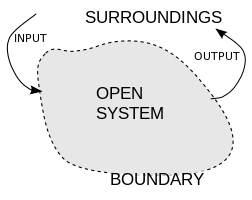
An open system is a system that has external interactions. Such interactions can take the form of information, energy, or material transfers into or out of the system boundary, depending on the discipline which defines the concept. An open system is contrasted with the concept of an isolated system which exchanges neither energy, matter, nor information with its environment. An open system is also known as a flow system.
The concept of an open system was formalized within a framework that enabled one to interrelate the theory of the organism, thermodynamics, and evolutionary theory. This concept was expanded upon with the advent of information theory and subsequently systems theory. Today the concept has its applications in the natural and social sciences.
In the natural sciences an open system is one whose border is permeable to both energy and mass. By contrast, a closed system is permeable to energy but not to matter.
The definition of an open system assumes that there are supplies of energy that cannot be depleted; in practice, this energy is supplied from some source in the surrounding environment, which can be treated as infinite for the purposes of study. One type of open system is the radiant energy system, which receives its energy from solar radiation – an energy source that can be regarded as inexhaustible for all practical purposes.
Example: Open systems have input and output flows, representing exchanges of matter, energy or information with its surroundings.
es: Sistema Abierto
Outer surface
Noun
Charged conductors that have reached electrostatic equilibrium share a variety of unusual characteristics. One characteristic of a conductor at electrostatic equilibrium is that the electric field anywhere beneath the surface of a charged conductor is zero. If an electric field did exist beneath the surface of a conductor (and inside of it), then the electric field would exert a force on all electrons that were present there. This net force would begin to accelerate and move these electrons. But objects at electrostatic equilibrium have no further motion of charge about the surface. So if this were to occur, then the original claim that the object was at electrostatic equilibrium would be a false claim. If the electrons within a conductor have assumed an equilibrium state, then the net force upon those electrons is zero. The electric field lines either begin or end upon a charge and in the case of a conductor, the charge exists solely upon its outer surface. The lines extend from this surface outward, not inward. This of course presumes that our conductor does not surround a region of space where there was another charge.
Example: The Biochemistry Of PhotosynthesisLight- Dependent Reaction (Fig 3): In both C 3 and C 4 plants, the chlorophyll molecules are arranged in the membranes of the thylakoids so that the haem group projects from the OUTER SURFACE.
es: Superficie exterior
Radiation
Noun
In physics, radiation is the emission or transmission of energy in the form of waves or particles through space or through a material medium.
Radiation is often categorized as either ionizing or non-ionizing depending on the energy of the radiated particles. Ionizing radiation carries more than 10 eV, which is enough to ionize atoms and molecules and break chemical bonds. This is an important distinction due to the large difference in harmfulness to living organisms. A common source of ionizing radiation is radioactive materials that emit α, β, or γ radiation, consisting of helium nuclei, electrons or positrons, and photons, respectively. Other sources include X-rays from medical radiography examinations and muons, mesons, positrons, neutrons and other particles that constitute the secondary cosmic rays that are produced after primary cosmic rays interact with Earth's atmosphere.
Example: The growth rate of the forest, derived by multiplying the amount of absorbed solar RADIATION by the RADIATION Use Efficiency (RUE) of the vegetation, was seen to change in response to variations in incoming solar RADIATION, leaf area index, extinction coefficient and RUE.
es: Radiación
Total energy
Noun
In physics, energy is the quantitative property that must be transferred to a body or physical system to perform work on the body, or to heat it. Energy is a conserved quantity; the law of conservation of energy states that energy can be converted in form, but not created or destroyed. The unit of measurement in the International System of Units (SI) of energy is the joule, which is the energy transferred to an object by the work of moving it a distance of one metre against a force of one newton.
The total energy of a system can be subdivided and classified into potential energy, kinetic energy, or combinations of the two in various ways. Kinetic energy is determined by the movement of an object – or the composite motion of the components of an object – and potential energy reflects the potential of an object to have motion, and generally is a function of the position of an object within a field or may be stored in the field itself.
Example: When the chlorine atoms are brought closer together, as in the case of the cis- isomer, the TOTAL ENERGY rises because the electrostatic repulsion increases and becomes a more significant contribution.
es: Energía total
Undergo
Verb
Experience or be subjected to (something, typically something unpleasant, painful, or arduous).
Example: Physical means of g and A Paramagnetic materials possess an unpaired electron which spin can be forced to UNDERGO a transition through the application of radiation.